Some Mexican dishes make you hungry before you even sit down.
Chiles rellenos are one of them.
It starts with the smell of poblano peppers roasting over an open flame.
The skins blister.
The kitchen fills with that unmistakable roasted chile aroma.
And you know something good is coming.
Then comes the cheese.
The fluffy egg batter.
The hot oil.
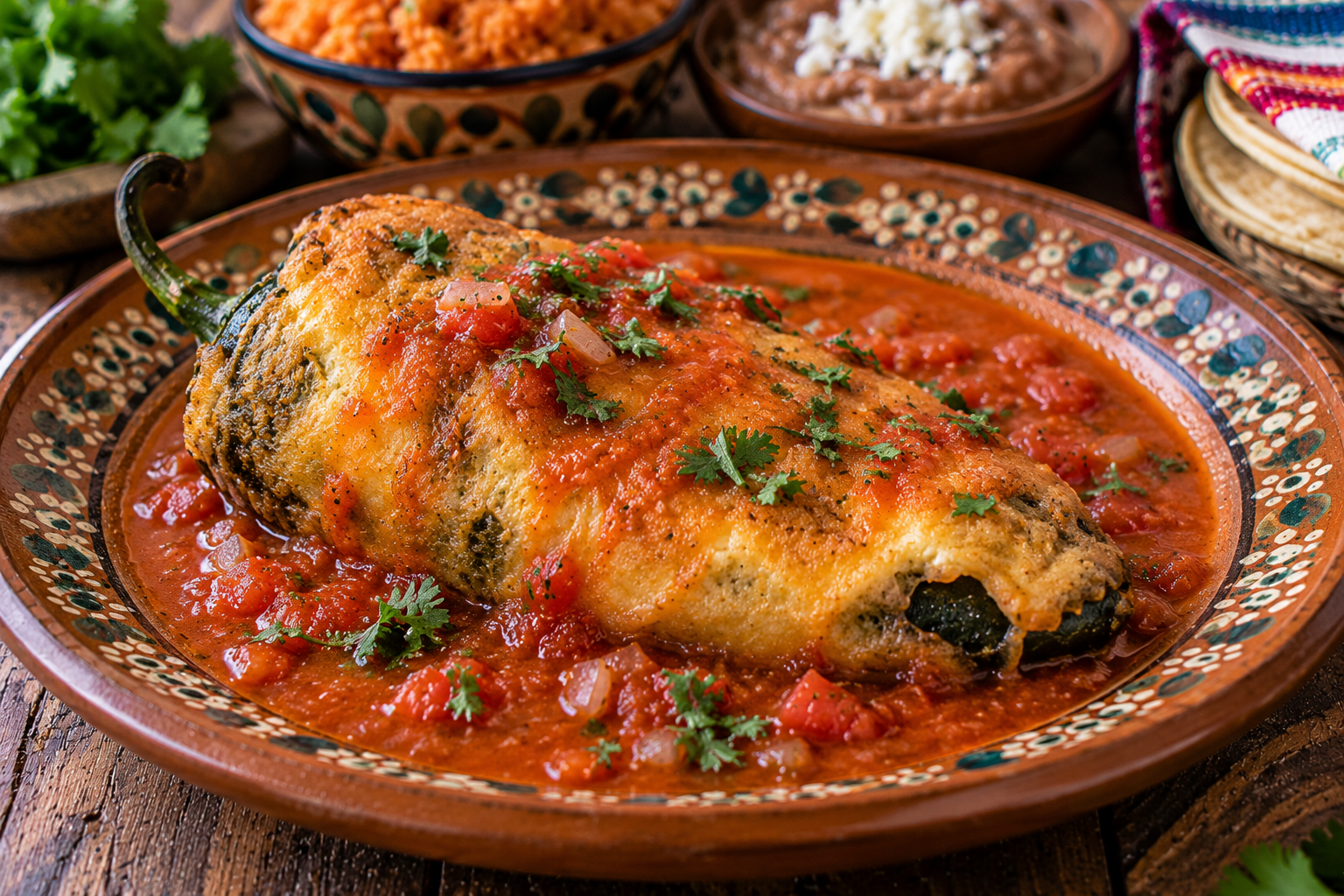
And finally, a golden chile relleno resting in a shallow pool of warm tomato caldillo.
Cut into it with your fork.
The poblano gives way.
The cheese stretches.
The golden coating soaks up just enough sauce.
And suddenly, all that preparation makes perfect sense.
Some Mexican dishes are worth slowing down for.
Chiles rellenos are one of them.
A Little Personal Chisme
One of the things I’ve learned while building The Half Jalapeño is that Mexican cooking has a way of making you appreciate the process.
Not every recipe is supposed to be quick.
Not every dish is meant to be thrown together in twenty minutes.
And honestly, I think that’s part of what makes this project so rewarding.
More than 100 posts into exploring Mexican food, I find myself paying more attention to the little things.
Why a pepper gets roasted before it’s stuffed.
Why egg whites are beaten separately.
Why a simple tomato sauce can make such a difference.
Those details tell us something about the people who developed these dishes and the cooks who continue preparing them.
Chiles rellenos are a perfect example.
You can’t rush your way through every step.
But when that first golden poblano comes out of the skillet, you understand why people keep making them.
Some recipes are about getting dinner on the table. Others remind you why cooking itself matters.
And I think we need both.
At a Glance
What It Is
Chiles rellenos are Mexican stuffed peppers, commonly made with roasted poblano chiles filled with cheese or picadillo. In this version, they’re coated in a fluffy egg batter, fried until golden, and served with a warm tomato caldillo.
Where It’s From
Chiles rellenos have strong historical connections to central Mexico, particularly Puebla, although stuffed chile preparations and regional variations are found throughout the country. Different communities use different peppers, fillings, cooking techniques, and sauces.
What Makes It Special
The contrast between the smoky poblano, melted cheese, airy golden coating, and savory tomato sauce. Each component brings something different, but together they create one of Mexican cooking’s most satisfying comfort dishes.
History & Cultural Context
A Chile With a Story to Tell
Before the cheese, before the batter, and before the tomato sauce, there was the chile.
Chiles have been part of Mexican food culture for thousands of years.
Long before European arrival, Indigenous communities throughout Mesoamerica cultivated and cooked with different varieties of peppers.
They weren’t simply a way to make food spicy.
Chiles brought flavor, aroma, color, and complexity to everyday meals.
From the mild, earthy poblano to the fiery chile de árbol, every chile brings its own personality to Mexican cooking. If you’ve ever wondered what makes these peppers so different, explore our Complete Guide to Mexican Chiles, where we break down their flavors, heat levels, regional uses, and the traditions behind them.
The poblano became especially important in central Mexican cooking.
Large, dark green, and relatively mild compared with many smaller chiles, it has a thick enough flesh and generous interior to make it particularly well suited for stuffing.
And somewhere along the way, Mexican cooks turned that practical quality into something extraordinary.
How Chiles Rellenos Became a Mexican Classic
The exact beginning of chiles rellenos isn’t tied to one universally documented moment.
Puebla is strongly associated with stuffed poblano preparations, but the broader tradition developed through multiple regions, ingredients, and generations of cooking.
The dish also reflects the changes Mexican cuisine experienced during the colonial period.
Indigenous ingredients such as chiles became part of preparations that incorporated ingredients and techniques introduced or expanded through Spanish colonial influence.
Cheese, wheat flour, and egg-based coatings all became part of different versions of the dish.
The combination produced something distinctly Mexican.
A roasted chile filled with flavorful ingredients, sometimes covered in beaten egg, fried, and served with sauce.
By the nineteenth century, recipes for chiles rellenos were appearing in Mexican cookbooks.
The 1831 cookbook El Cocinero Mexicano, for example, included a preparation using roasted chiles filled with seasoned pork, coated with beaten egg, and fried.
That’s an important detail.
It reminds us that the cheese-filled version we recognize today is part of a much larger family of stuffed chile recipes.
Not Every Chile Relleno Is the Same
Travel through Mexico and the preparation changes.
Some cooks use poblano peppers.
Others use ancho, jalapeño, or other regional chile varieties.
Some fill them with cheese.
Others use picadillo, vegetables, seafood, or combinations of ingredients.
Some are capeados, meaning they’re coated in beaten egg batter before frying.
Others are prepared without the coating.
And while a warm tomato caldillo is especially familiar in central Mexican cooking, it isn’t the only way to serve a stuffed chile.
That’s one of the things I love about this dish.
Chiles rellenos aren’t defined by one single recipe. They’re part of a living Mexican cooking tradition.
For our Comfort Classics version, we’re preparing one of the most recognizable combinations.
Roasted poblano peppers.
Melting cheese.
A fluffy golden egg coating.
And homemade tomato caldillo.
Nothing unnecessary.
Just the flavors and techniques that make this version so memorable.
Why Chiles Rellenos Belong in Comfort Classics
There’s something different about the comfort that comes from a dish like this.
It’s not necessarily an everyday thirty-minute dinner.
It asks for a little patience.
Roast the chiles.
Let them steam.
Peel them carefully.
Prepare the filling.
Beat the eggs.
Fry each pepper.
Warm the sauce.
And then bring everything together.
It’s a process.
But it’s also the kind of cooking that can make an ordinary meal feel like an occasion.
After exploring the simple beauty of Frijoles de la Olla and the crunchy chaos of Tostadas de Pollo, we’re moving into another side of Mexican comfort food.
The kind that rewards a little extra effort.
And when you put a golden chile relleno on a plate with warm tomato sauce, Mexican rice, and beans, you don’t need much else.
That’s a meal worth sitting down for.
Ingredients You’ll Need
Poblano Peppers
Choose six large, firm poblano peppers with smooth skin and sturdy stems.
Look for peppers that are broad enough to hold a generous cheese filling.
Oaxaca Cheese
Oaxaca cheese melts beautifully and gives the filling that soft, stretchy texture.
Monterey Jack is a convenient alternative if Oaxaca cheese isn’t available.
Eggs
The traditional-style fluffy coating starts with separating the eggs and beating the whites until they hold stiff peaks.
The yolks are then incorporated to create a light batter.
All-Purpose Flour
A light dusting helps the egg coating cling to the roasted peppers.
You don’t need a thick layer.
Tomatoes
Ripe Roma tomatoes form the foundation of our caldillo.
They bring sweetness, acidity, and a beautiful red color.
Onion and Garlic
These simple aromatics give the sauce its savory foundation.
Chicken or Vegetable Broth
A little broth helps turn the blended tomatoes into a light, pourable caldillo rather than a thick salsa.
Mexican Oregano
A small amount adds an earthy, aromatic finish to the sauce.
Neutral Oil
Use an oil suitable for frying, such as canola or vegetable oil.
The peppers should fry gently until their egg coating is puffed and golden.
As an Amazon Associate, I earn from qualifying purchases. If you buy through the links below, it helps support The Half Jalapeño at no extra cost to you. ¡Gracias!
Chiles Rellenos:
Ingredients
- For the Chiles Rellenos
- 6 large poblano peppers
- 12 ounces Oaxaca cheese shredded or cut into strips
- 5 large eggs separated
- ½ cup all-purpose flour for dusting
- ½ teaspoon kosher salt
- Neutral oil for frying approximately 1 to 1½ cups depending on skillet size
- For the Tomato Caldillo
- 5 medium Roma tomatoes roughly chopped
- ¼ medium white onion
- 2 garlic cloves
- 1½ cups chicken or vegetable broth
- 1 tablespoon neutral oil
- ½ teaspoon Mexican oregano
- ½ teaspoon kosher salt or to taste
- ¼ teaspoon freshly ground black pepper
Instructions
- Roast the Poblanos
- Place the poblano peppers directly over a gas flame, on a hot comal, or under the oven broiler.
- Turn occasionally until the skins are blistered and charred on all sides, approximately 8 to 12 minutes depending on the method.
- The goal is to loosen the skins while softening the peppers enough to make them pliable.
- Steam the Peppers
- Transfer the roasted poblanos to a covered bowl and let them steam for 10 minutes.
- Once cool enough to handle, gently rub away the blistered skins.
- Avoid rinsing under running water if possible, since that can wash away some of the roasted flavor.
- Remove the Seeds
- Carefully cut a slit down one side of each poblano.
- Remove the seeds and thick inner membranes while keeping the pepper as intact as possible.
- Leave the stem attached if you can.
- Stuff With Cheese
- Divide the Oaxaca cheese evenly among the six peppers.
- Gently close the openings around the filling.
- If necessary, secure each pepper with one or two wooden toothpicks. Remember to remove them before serving.
- Prepare the Tomato Caldillo
- Blend the tomatoes, onion, garlic, and broth until smooth.
- Heat 1 tablespoon oil in a saucepan over medium heat.
- Carefully pour in the blended mixture.
- Add the Mexican oregano, salt, and black pepper.
- Bring to a gentle simmer and cook for 15 to 20 minutes, stirring occasionally, until the raw tomato flavor has mellowed and the sauce is slightly reduced.
- Taste and adjust seasoning.
- Keep warm over low heat.
- Prepare the Egg Batter
- Separate the eggs, placing the whites in a clean, dry mixing bowl.
- Beat the egg whites with an electric mixer until stiff, glossy peaks form.
- Lightly beat the yolks with the salt.
- Gently fold the yolks into the whipped whites, taking care not to deflate the mixture.
- Work promptly because the batter gradually loses volume.
- Dust the Peppers
- Pat the stuffed poblanos dry with paper towels.
- Lightly coat each pepper with flour, shaking off the excess.
- This helps the egg batter adhere.
- Heat the Oil
- Pour enough neutral oil into a heavy skillet to reach approximately ½ inch deep.
- Heat to around 350°F.
- The oil should be hot enough to puff and set the batter without burning it.
- Coat and Fry
- Working with one or two peppers at a time, gently coat each stuffed poblano in the egg batter.
- Carefully lower it into the hot oil.
- Fry for approximately 2 to 3 minutes per side, turning gently, until the coating is puffed, golden, and cooked through.
- Adjust the heat as needed to maintain a steady frying temperature.
- Drain
- Transfer the fried chiles rellenos to a wire rack set over a baking sheet or to a paper towel-lined plate.
- Allow excess oil to drain.
- Repeat with the remaining peppers.
- Assemble
- Spoon warm tomato caldillo onto individual plates.
- Place one chile relleno over the sauce.
- Add a little more caldillo around the pepper if desired.
- Serve
- Serve immediately while the coating is golden and the cheese is warm and melted.
- Mexican rice, beans, and warm corn tortillas make excellent accompaniments.
Notes
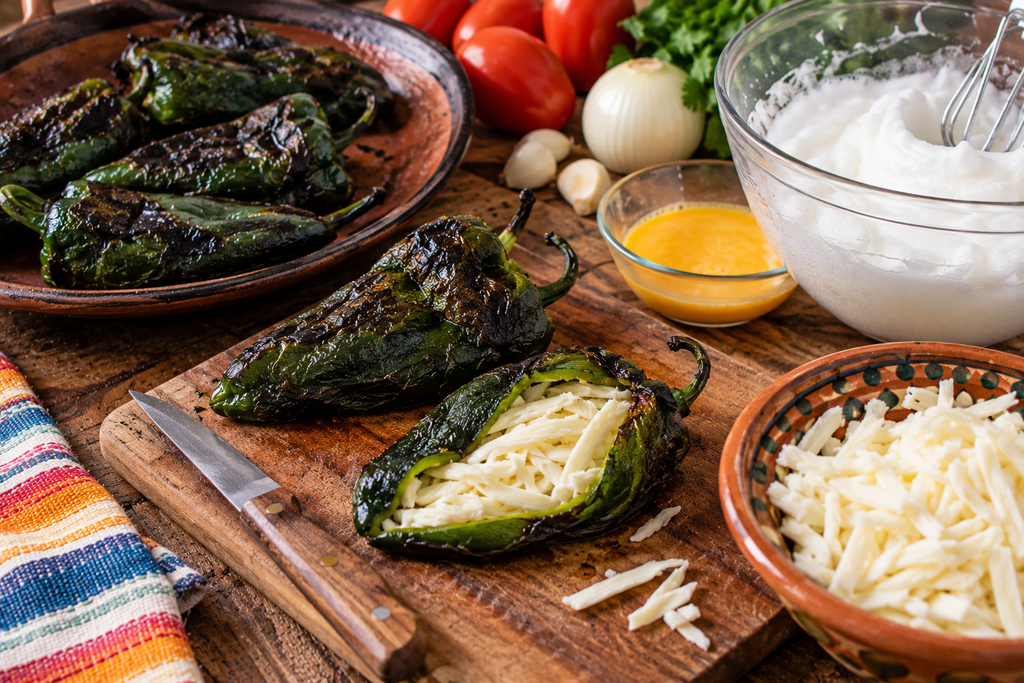
The making of traditional chiles rellenos begins with smoky roasted poblanos stuffed with Oaxaca cheese, ready to be coated in fluffy egg batter and fried until golden perfection
How to Get That Perfect Golden Egg Coating
The fluffy coating is one of the defining features of this style of chiles rellenos.
And it’s probably the part that intimidates home cooks the most.
But once you understand what the eggs are doing, the technique becomes much easier.
Start With Clean Equipment
Egg whites whip best when the mixing bowl and beaters are completely clean and free of grease.
Even a little egg yolk can make whipping more difficult.
Beat Until Stiff Peaks Form
You want the whites to hold their shape when the beaters are lifted.
They should look glossy and airy, not dry or grainy.
Fold Gently
Once the yolks are added, fold them into the whites with a spatula.
Don’t stir aggressively.
You’re trying to preserve the air that makes the coating puff during frying.
Fry Immediately
Egg batter doesn’t improve by sitting around.
Once it’s ready, coat the peppers and begin frying.
Watch the Oil Temperature
If the oil is too cool, the coating can absorb excess oil.
If it’s too hot, the outside can brown before the egg is cooked through.
Aim for a steady, moderate fry.
The goal is a light golden coating that complements the chile rather than overwhelming it.
Why the Tomato Caldillo Matters
It’s tempting to think of the sauce as an afterthought.
But the caldillo plays an important role.
The roasted poblano brings earthy chile flavor.
The cheese brings richness.
The egg coating brings a delicate, savory crust.
The tomato sauce balances all three.
Its acidity keeps the dish from feeling too heavy.
Its savory broth adds moisture.
And when the sauce meets the golden coating, the textures come together beautifully.
I like keeping the caldillo relatively light.
Not watery.
Not thick like pasta sauce.
Just enough body to coat a spoon and settle around the chile.
The sauce shouldn’t hide the chile relleno. It should make every bite better.
What to Serve With Chiles Rellenos
A chile relleno with warm tomato caldillo can easily be the centerpiece of dinner.
But a few familiar Mexican sides make the meal even better.
Arroz Rojo
Mexican red rice is a natural partner for the tomato sauce and rich cheese filling.
Frijoles de la Olla
A bowl of brothy beans adds an earthy, comforting contrast.
Warm Corn Tortillas
Perfect for enjoying the last of the caldillo and melted cheese.
Fresh Salsa
A spoonful of salsa verde or a brighter table salsa can add another layer of flavor.
Simple Green Salad
If you want something lighter alongside the fried peppers, crisp greens with lime make a refreshing addition.
Variations Worth Exploring
Chiles Rellenos de Picadillo
Replace the cheese with a cooked, well-drained picadillo filling.
This is another important traditional preparation with many regional interpretations.
Chiles Rellenos Without Batter
Skip the egg coating and serve the roasted, stuffed peppers warmed through with tomato sauce.
The result is lighter and lets the poblano flavor stand out.
Mixed Cheese Filling
Combine Oaxaca cheese with Monterey Jack for a creamy, stretchy filling.
Spicier Caldillo
Blend a small serrano or jalapeño into the tomato sauce for extra heat.
Baked Chiles Rellenos
For a different preparation, arrange stuffed poblanos in a baking dish with sauce and bake until the cheese melts.
This won’t reproduce the airy fried egg coating, but it’s a practical alternative.
Storage & Reheating
Chiles rellenos are at their best immediately after frying, when the coating is golden and the cheese is melted.
However, leftovers can still be delicious.
Refrigerator
Store cooked chiles rellenos in an airtight container for up to 3 to 4 days.
Keep the tomato caldillo in a separate container when possible.
Refrigerate promptly, within two hours of cooking.
Reheating
For the best texture, place the peppers on a baking sheet and reheat in a 350°F oven until thoroughly heated to 165°F.
Warm the caldillo separately in a saucepan.
Pour the sauce onto the plate just before serving.
The coating won’t be quite as fluffy as when freshly fried, but separating the sauce helps prevent unnecessary sogginess.
Freezing
You can freeze cooked chiles rellenos, although the egg coating may soften after thawing.
For best quality, freeze them individually before transferring to an airtight freezer-safe container.
Use within approximately 2 to 3 months for best quality.
Thaw safely in the refrigerator and reheat thoroughly.
My Go-To Tools for Mexican Cooking
These are the tools I personally recommend for building real Mexican flavor at home, the kind that gets stained with salsa, smells like toasted chiles, and earns a permanent spot in your kitchen.
Cast Iron Tortilla Press – Fresh tortillas make every taco better.
Cast Iron Skillet (Comal Alternative) – Perfect for searing meats, warming tortillas, and building incredible flavor.
Tortilla Warmer – Keeps tortillas soft, warm, and ready for taco night.
Non-Stick Comal – One of the best tools for roasting tomatoes, tomatillos, garlic, onions, and chiles.
Ninja Professional Blender (1000W) – Essential for silky salsa verde, salsa roja, marinades, and sauces.
Granite Molcajete – The traditional way to make salsa with unbeatable texture and authentic flavor.
Wooden Rolling Pin – A versatile kitchen staple that always earns its keep.
Lodge 6-Quart Enameled Dutch Oven – Perfect for birria, barbacoa, beans, soups, stews, braises, and slow-cooked Mexican favorites.
Mexican Kitchen Essentials
For the tools I use to make tacos, salsas, sides, and everyday Mexican food at home:
👉 Shop My Mexican Kitchen Essentials
Frequently Asked Questions
What are chiles rellenos?
Chiles rellenos are Mexican stuffed peppers, commonly prepared with roasted poblanos filled with cheese or picadillo. Many versions are coated in beaten egg batter, fried, and served with tomato sauce.
Are chiles rellenos spicy?
Poblano peppers are generally mild to moderately spicy, but individual peppers can vary.
Removing the seeds and inner membranes can help reduce some of the heat.
What cheese is best for chiles rellenos?
Oaxaca, Chihuahua, and Monterey Jack are all good melting cheeses.
For this recipe, Oaxaca cheese is my first choice.
Do I have to peel the poblanos?
Peeling is recommended for this traditional-style preparation because the blistered outer skin can be tough and unpleasant to eat.
Why does my egg batter fall off?
The peppers may be too wet, the flour coating may be insufficient, or the batter may have lost too much air.
Pat the peppers dry, dust them lightly with flour, and fry soon after whipping the eggs.
Can I make chiles rellenos without frying?
Yes. You can bake stuffed poblanos with sauce, although the result will differ from traditional capeados.
Can I make the tomato sauce ahead of time?
Absolutely.
Prepare the caldillo a day or two in advance, refrigerate it, and reheat before serving.
What’s the difference between chiles rellenos and chiles en nogada?
Chiles en nogada are a specific Mexican preparation associated with Puebla, commonly featuring a fruit-and-meat filling, walnut-based sauce, and pomegranate garnish.
Chiles rellenos is the broader category of stuffed chile dishes.
Can I use Anaheim peppers?
Yes. Anaheim peppers can work as an alternative, although their shape, flavor, and heat differ from poblanos.
Why are my chiles rellenos greasy?
The oil may have been too cool, the batter may have been too heavy, or the peppers may not have drained properly.
Use a thermometer when possible and allow the finished peppers to drain before serving.
More From The Half Jalapeño
Chiles rellenos are a reminder that some of Mexico’s most memorable dishes are built through technique as much as ingredients.
Roasting.
Peeling.
Stuffing.
Whipping.
Frying.
Simmering.
Each step contributes something.
And that’s exactly what we’re exploring throughout Comfort Classics.
Explore More Authentic Mexican Favorites
Discover the Mexican home-style dishes that bring families together, from simple everyday favorites to recipes worth spending a little extra time preparing.
Explore the regional flavors, traditions, and stories behind Mexico’s incredible variety of tacos.
Learn about the sauces that bring depth, brightness, heat, and personality to Mexican cooking.
Explore the savory bites, crispy favorites, and regional specialties that make Mexican street food unforgettable.
At The Half Jalapeño, we’re not just collecting recipes.
We’re building a living archive of Mexican cooking, one dish, one region, and one family table at a time.
Pair It With Authentic Mexican Flavor
The classic Mexican red rice that belongs alongside so many home-cooked meals.
Simple, brothy Mexican beans that make a beautiful companion to a rich chile relleno.
A bright roasted tomatillo salsa that brings a fresh contrast to the cheese and golden egg coating.
Explore another beloved Mexican comfort dish and a filling that can also inspire different styles of chiles rellenos.
Some recipes show us what Mexican food tastes like.
Others show us how much care goes into making it.
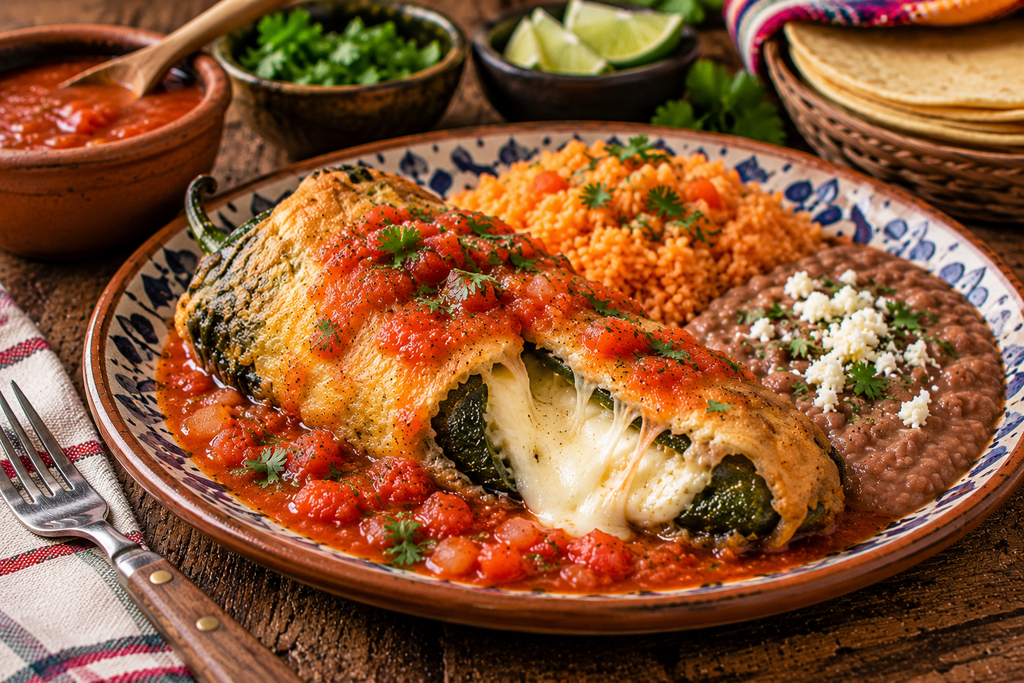
A golden, crispy chile relleno sliced open to reveal melted Oaxaca cheese, nestled in warm tomato caldillo and served alongside Mexican rice and refried beans. A comforting Mexican classic worth every step
The Final Bite
There’s something satisfying about a recipe that makes you work just a little harder for the finished dish.
Chiles rellenos are one of those recipes.
You can’t simply throw everything into a skillet and walk away.
You have to pay attention.
Watch the poblanos blister.
Peel them carefully.
Make room for the cheese.
Whip the eggs.
Get the oil just right.
And trust the process.
Then comes the moment that makes it all worthwhile.
A golden chile relleno resting in warm tomato sauce.
A fork cutting through the fluffy coating.
The smoky poblano underneath.
And melted cheese waiting in the center.
That’s when you realize the extra effort wasn’t an inconvenience.
It was part of the experience.
And after more than 100 recipes at The Half Jalapeño, that’s something I appreciate more than ever.
Mexican cooking isn’t always about doing things the fastest way.
Sometimes it’s about understanding why certain techniques have been passed from one kitchen to another.
Why some dishes become traditions.
Why people keep returning to recipes that ask a little more of them.
Because some meals are worth the extra time.
And some recipes are worth learning properly.
That’s Chiles Rellenos.
Roasted poblanos, melty cheese, and golden perfection.
Buen provecho,
Join the Comal Crew
Love Mexican food with a story behind it?
Join the Comal Crew and get new recipes, regional food stories, kitchen tips, and everything we’re building at The Half Jalapeño delivered straight to your inbox.
Every Tuesday, we’re opening another door into Mexican cooking.
And I’d love to have you along for the journey.
Plus, grab your free guide:
5 Mexican Salsas That Go With Everything
Because a good salsa can turn even the simplest meal into something worth remembering.