Some foods become famous because they’re complicated.
Frijoles de la olla became essential because they’re not.
A pot. Beans. Water. Onion. Garlic. Salt.
That’s about as humble as dinner gets.
And yet it’s hard to tell the story of Mexican cooking without eventually finding a pot of beans somewhere in the kitchen.
They’re eaten whole and brothy straight from the pot.
Tomorrow they might become refried beans.
The next day they could end up alongside eggs, underneath cheese, next to rice, or folded into a tortilla.
One pot keeps becoming dinner.
And it has been doing that for a very long time.
Beans aren’t the supporting actor we’re sometimes tempted to make them.
Long before the combination plate put a scoop of beans next to rice and called it a side, beans were already deeply woven into Mexican agriculture, cooking, and everyday life.
Maybe that’s why this recipe feels different from some of the others we’ve cooked in Comfort Classics.
We’re not recreating something elaborate.
We’re going back to one of the foundations.
A Little Personal Chisme
The more I build The Half Jalapeño, the more I find myself appreciating the dishes that don’t necessarily look like headline material.
When I started this site, it was easy to get excited about tacos, birria, carne asada, and the dishes everybody recognizes immediately.
But more than 100 posts later, I’ve started looking at Mexican food differently.
Sometimes the most important recipe isn’t the one everybody takes a picture of.
It’s the pot sitting quietly on the stove that makes half the rest of the meal possible.
That’s what I love about frijoles de la olla.
They’re not trying to impress anybody.
They’ve just been feeding people.
And the deeper I get into this project, the more I realize those are exactly the stories I want The Half Jalapeño to preserve.
At a Glance
What It Is
Frijoles de la olla are whole dried beans slowly cooked in water with simple aromatics until tender and surrounded by a flavorful broth. Depending on the household and region, additions can include onion, garlic, epazote, other herbs, or a little fat.
Where It’s From
This is a traditional Mexican preparation rather than the specialty of one single state. Beans themselves have ancient roots in Mesoamerica, while regional versions of pot beans vary according to the beans, herbs, seasonings, and serving traditions available locally.
What Makes It Special
Frijoles de la olla are both a finished dish and a beginning. Eat them hot from the pot with their broth, or turn the leftovers into refried beans, soups, fillings, and countless other meals. Mexican agricultural authorities describe beans as a fundamental part of the country’s traditional diet, while Larousse describes frijoles de la olla as the beans’ foundational first cooking.
History & Cultural Context
If we’re going to understand why a simple pot of beans matters so much, we have to go back much further than the modern Mexican kitchen.
Beans of the genus Phaseolus are native to the Americas. Mexican government agricultural sources identify Mesoamerica and the Andean region as major centers of bean diversity, and western Mexico as an important area in the domestication history of the common bean, Phaseolus vulgaris. Mexico remains extraordinarily diverse in wild and cultivated beans.
Evidence of their cultivation reaches back thousands of years.
Mexican biodiversity authorities describe beans as having been cultivated for roughly 8,000 years, while archaeological evidence cited by Mexico’s Agriculture Ministry places bean cultivation in Mesoamerica thousands of years before European contact. The exact dates differ among sources and archaeological interpretations, but the larger point is clear: beans were part of Mexican foodways long before Mexico existed as a modern nation.
And they weren’t growing alone.
Beans became part of the agricultural world of the milpa, the traditional Mesoamerican polyculture centered on corn and accompanied by crops such as beans, squash, chiles, tomatoes, and others depending on the region.
Corn, beans, and squash are often described as the Mesoamerican triad.
That relationship matters beyond history.
A milpa isn’t simply three vegetables planted next to one another. It’s an agricultural system that developed over generations and varies from place to place. Mexico’s biodiversity agency describes it as a dynamic reservoir of genetic resources, with different plants and foods incorporated according to local ecology and tradition.
And eventually those crops meet again at the table.
Corn becomes tortillas.
Chiles become salsa.
Beans go into the pot.
Suddenly the foundation of an enormous amount of Mexican cooking is sitting in front of you.
So Why “de la Olla”?
Literally, frijoles de la olla means “beans from the pot.”
Larousse’s Diccionario Enciclopédico de la Gastronomía Mexicana describes them as beans cooked in water with ingredients such as onion, garlic, salt, fat, and herbs. It also notes that the traditional use of an olla de barro, or clay pot, is the origin of the name.
But there isn’t one universal Mexican pot of beans.
That’s important.
Larousse documents regional differences in everything from the bean itself to the herbs and garnishes. Black beans are common in parts of the Gulf, south, and southeast, while other regions use varieties such as bayos or flor de mayo. Epazote is common, but cilantro and parsley can appear too.
So this recipe shouldn’t be treated as the one way Mexico cooks beans.
It is our version of one of Mexico’s foundational cooking methods.
And that’s a distinction worth preserving.
Why Frijoles de la Olla Belong in Comfort Classics
We’ve had some attention grabbers in this series.
We’ve melted cheese over Enchiladas Suizas.
We’ve simmered beef for Carne con Papas.
We’ve made a bowl of Sopita de Conchas that practically announces what this series is about.
Now we’re cooking beans.
And somehow, that might bring us closer to the heart of Comfort Classics than almost anything we’ve made yet.
Because comfort food isn’t always the special meal.
Sometimes it’s the food that’s simply there.
The pot that feeds everyone once and then keeps feeding them in different forms.
Today’s frijoles de la olla can become tomorrow’s frijoles refritos.
Spoon them next to rice.
Serve them with tortillas.
Put them alongside eggs.
Mash them.
Use them as a filling.
Turn them into another meal entirely.
That’s not flashy cooking.
That’s useful cooking.
And Mexican home cooking has always understood the difference.
Ingredients You’ll Need
This is where simplicity becomes important.
When there are only a handful of ingredients in the pot, every one of them matters.
Dried Pinto Beans
I’m using pinto beans for this version because they’re easy to find and cook into beautifully creamy beans while still holding their shape.
But they aren’t the only correct choice.
Mexico has enormous bean diversity, and regional cooks use different varieties. Bayos, flor de mayo, black beans, and other beans can all lead to a legitimate pot of frijoles de la olla.
Water
Not broth.
Water.
The beans create their own broth as they cook.
White Onion
Half an onion slowly perfumes the cooking liquid without turning this into onion soup.
Garlic
A few cloves add another quiet layer of flavor.
Epazote
Epazote has a distinctive herbal flavor and is traditionally used with beans in Mexican cooking. Larousse notes that herbs vary regionally, with epazote among the most common.
If you can’t find it, don’t let that stop you from making the beans.
Salt
Beans need enough salt to taste like something.
We’ll season the pot and make a final adjustment once the beans are tender and the broth has developed.
As an Amazon Associate, I earn from qualifying purchases. If you buy through the links below, it helps support The Half Jalapeño at no extra cost to you. ¡Gracias!
Frijoles de la Olla Recipe
Ingredients
- 1 pound dried pinto beans
- 8 cups water plus more as needed
- ½ medium white onion
- 3 garlic cloves peeled
- 1 large sprig fresh epazote optional
- 1½ teaspoons kosher salt plus more to taste
- Optional for Serving
- – Chopped white onion
- – Chopped cilantro
- – Crumbled queso fresco
- – Sliced serrano chile
- – Lime wedges
- – Warm corn tortillas
Instructions
- Spread the dried beans out on a baking sheet or clean work surface and pick through them, removing any small stones, debris, or damaged beans.
- Rinse the beans thoroughly under cool running water.
- Add the beans to a large heavy pot or Dutch oven with 8 cups of water, the onion, and garlic.
- Bring the pot to a boil, then reduce the heat to maintain a gentle simmer.
- Partially cover the pot and cook until the beans begin to soften, checking occasionally to make sure they remain covered with liquid. Add hot water as necessary.
- After about 1 hour, begin checking the beans periodically for tenderness. Cooking time can vary significantly depending on the variety and age of the beans.
- Once the beans are mostly tender, add the epazote and salt.
- Continue simmering until the beans are completely tender and creamy inside but still mostly intact. The cooking liquid should have developed into a flavorful, lightly thickened bean broth.
- Remove the onion, garlic, and epazote stem if desired.
- Taste the broth and adjust the salt.
- Ladle the beans into bowls with plenty of their broth.
- Serve simply or finish with chopped onion, cilantro, queso fresco, serrano, or lime according to your preference.
Notes
No. Larousse publishes traditional frijoles de la olla methods both with and without soaking, so soaking isn’t a requirement for authenticity. It can shorten or make cooking time more predictable, but we’re using an unsoaked stovetop method here. Keep an eye on the water.
The beans should remain submerged while cooking. Add hot water when needed. Bean age matters.
Older dried beans can take considerably longer to soften, so use tenderness rather than the clock as your final test. Don’t cook them at a violent boil.
A steady simmer is enough. Want black beans instead?
Use them. Regional Mexican preparations vary considerably, and black beans are particularly associated with parts of southern and southeastern Mexico.
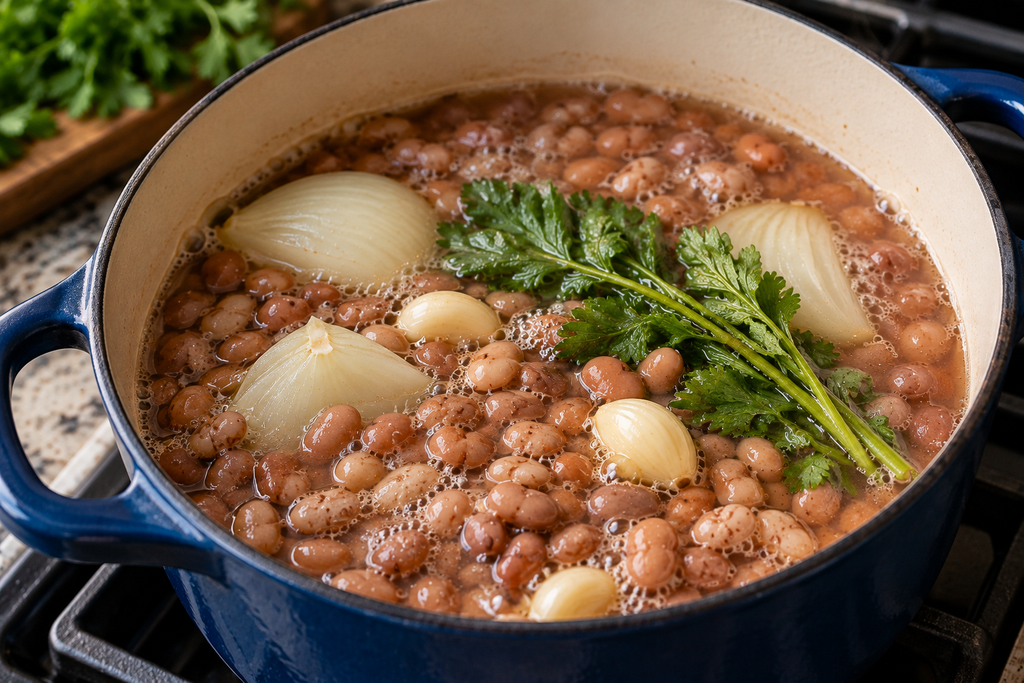
Pinto beans gently simmer with onion, garlic, and epazote until tender and surrounded by a rich, flavorful bean broth.
Do You Have to Soak Beans Overnight?
This is one of those kitchen arguments that can become much bigger than the pot deserves.
For frijoles de la olla, no, you don’t have to soak them.
Larousse documents both approaches in its Mexican cooking resources. One recipe soaks the beans overnight, while another explicitly says soaking isn’t necessary.
Soaking can shorten the cooking time and make it somewhat more predictable.
But if you forgot?
Cook the beans.
They’ll be fine.
The Broth Is Part of the Dish
Don’t drain these.
Please.
The liquid surrounding properly cooked frijoles de la olla isn’t leftover cooking water.
It’s bean broth.
As the beans simmer, starch and flavor move into the liquid around them until plain water becomes something savory enough to eat with a spoon.
That’s why the ideal bowl isn’t just a pile of beans.
You want some caldo.
Larousse’s culinary dictionary specifically describes frijoles de la olla as having an abundant, somewhat thick broth.
Grab a tortilla.
Now we’re getting somewhere.
How Do You Know When the Beans Are Done?
Eat one.
Seriously.
A properly cooked bean should be creamy all the way through.
No chalky center.
No resistance that makes you wonder whether you just bit into a peanut.
The skins should mostly remain intact, although some beans splitting is completely normal and actually helps thicken the broth.
The clock can point you in the right direction.
The bean makes the final decision.
Why Does My Cooking Time Keep Changing?
Because dried beans aren’t manufactured widgets.
Variety matters.
Age matters.
Storage matters.
Your water matters.
Your pot matters.
Your heat matters.
That’s why I’d rather tell you what a finished bean feels like than promise that every bag in America will become tender at exactly 1 hour and 47 minutes.
Start checking.
Keep simmering.
Let the beans tell you when they’re ready.
What to Serve With Frijoles de la Olla
You could serve these beans beside almost anything in the THJ library.
But they don’t actually need much.
A bowl of beans.
Warm corn tortillas.
Maybe chopped onion, cilantro, crumbled queso fresco, or a spoonful of salsa.
That’s already food.
For a larger plate, add Arroz Rojo, grilled meat, eggs, or one of our Comfort Classics.
And whatever you do, keep the leftovers.
Because tomorrow we’re going to understand why cooking a full pot was such a good idea.
One Pot, More Than One Meal
This might be my favorite thing about frijoles de la olla.
They’re not finished when dinner is over.
Reheat them tomorrow exactly as they are.
Mash some and turn them into refried beans.
Use them with huevos for breakfast.
Spread mashed beans onto a tostada.
Stuff them into a gordita.
Serve them with rice.
Add them to another soup or stew.
Larousse specifically describes this first cooking of beans as a base that can go on to soups, creams, refried beans, and other preparations.
One pot becomes a starting point.
That’s smart cooking.
Storage & Reheating
Refrigerator
Let the beans cool and refrigerate them in an airtight container with their cooking broth.
Use within about 4 days.
Reheating
Reheat gently on the stovetop over medium-low heat.
The beans will continue absorbing liquid in the refrigerator, so add a splash of water if they’ve become thicker than you want.
Freezing
Frijoles de la olla freeze extremely well.
Cool them completely, portion them into freezer-safe containers with plenty of broth, leave room for expansion, and freeze.
For best quality, use them within about 3 months.
Thaw overnight in the refrigerator or reheat gently from frozen.
My Go-To Tools for Mexican Cooking
These are the tools I personally recommend for building real Mexican flavor at home, the kind that gets stained with salsa, smells like toasted chiles, and earns a permanent spot in your kitchen.
Cast Iron Tortilla Press – Fresh tortillas make every taco better.
Cast Iron Skillet (Comal Alternative) – Perfect for searing meats, warming tortillas, and building incredible flavor.
Tortilla Warmer – Keeps tortillas soft, warm, and ready for taco night.
Non-Stick Comal – One of the best tools for roasting tomatoes, tomatillos, garlic, onions, and chiles.
Ninja Professional Blender (1000W) – Essential for silky salsa verde, salsa roja, marinades, and sauces.
Granite Molcajete – The traditional way to make salsa with unbeatable texture and authentic flavor.
Wooden Rolling Pin – A versatile kitchen staple that always earns its keep.
Lodge 6-Quart Enameled Dutch Oven – Perfect for birria, barbacoa, beans, soups, stews, braises, and slow-cooked Mexican favorites.
Mexican Kitchen Essentials
For the tools I use to make tacos, salsas, sides, and everyday Mexican food at home:
👉 Shop My Mexican Kitchen Essentials
Frequently Asked Questions
What are Frijoles de la Olla?
Frijoles de la olla are whole beans cooked in water with simple seasonings and served with their broth. Traditional additions can include onion, garlic, salt, fat, epazote, cilantro, or other herbs depending on the region and cook.
What does Frijoles de la Olla mean?
Literally, it means “beans from the pot.” Larousse connects the name specifically with the traditional clay pot, or olla de barro, used to cook them.
What beans are best for Frijoles de la Olla?
There isn’t one required bean. Pinto beans work beautifully for this recipe, while bayos, flor de mayo, black beans, and other regional varieties are also used in Mexican cooking.
Do I have to soak the beans?
No. Traditional and contemporary Mexican recipes use both soaked and unsoaked approaches.
Do I need an olla de barro?
No.
A clay pot is traditional and historically connected with the dish’s name, but a Dutch oven or other heavy pot works very well.
Should Frijoles de la Olla be soupy?
They should be brothy, rather than dry. Larousse describes the cooking liquid as abundant and somewhat thickened.
Is epazote required?
No. It’s traditional and common, but regional seasoning varies. Larousse also documents cilantro and parsley among herbs used in different preparations.
Can I turn these into refried beans?
Absolutely.
In fact, that’s one of the best reasons to make a full pot. Frijoles de la olla are commonly used as the starting point for refried beans and other bean dishes.
More From The Half Jalapeño
Frijoles de la olla might be one of the simplest recipes we’ve put into Comfort Classics.
They might also be one of the most important.
Because understanding Mexican cooking isn’t only about learning the famous dishes.
It’s about understanding the foods underneath them.
The tortillas.
The chiles.
The salsas.
The beans.
The everyday building blocks that keep appearing in different combinations from one meal to the next.
Frijoles de la Olla are part of our Comfort Classics series, where we’re preserving the home-style dishes that don’t need a special occasion to matter.
Explore More Authentic Mexican Favorites
Comfort Classics
Follow the series as we build a collection around the Mexican dishes that taste like home.
The Complete Taco Series
Explore regional tacos, street-food classics, guisados, and the tortillas that carry them.
Mexican Salsas & Sauces Guide
Because if we’re putting a pot of beans and tortillas on the table, somebody is eventually going to ask where the salsa is.
Soups & Stews
Explore another side of Mexican comfort food through brothy bowls, slow-cooked meats, vegetables, and deeply flavored family meals.
At The Half Jalapeño, we’re not just collecting recipes.
We’re building a living archive of Mexican cooking, one dish, one region, and one family table at a time.
🌶 Pair It With Authentic Mexican Flavor
Arroz Rojo
Beans and Mexican red rice don’t need much explanation. There’s a reason they keep finding each other on the same plate.
Salsa Verde Asada
Roasted tomatillos and chiles bring brightness and acidity to a bowl of earthy beans.
Pico de Gallo
Tomato, onion, cilantro, chile, and lime give the whole plate a fresh counterpoint.
Guacamole Taquero
Creamy avocado and chile turn a humble bowl of beans and tortillas into the kind of meal where nobody feels like anything is missing.
A pot of beans doesn’t need much help.
It just knows how to make everything around it feel more like dinner.
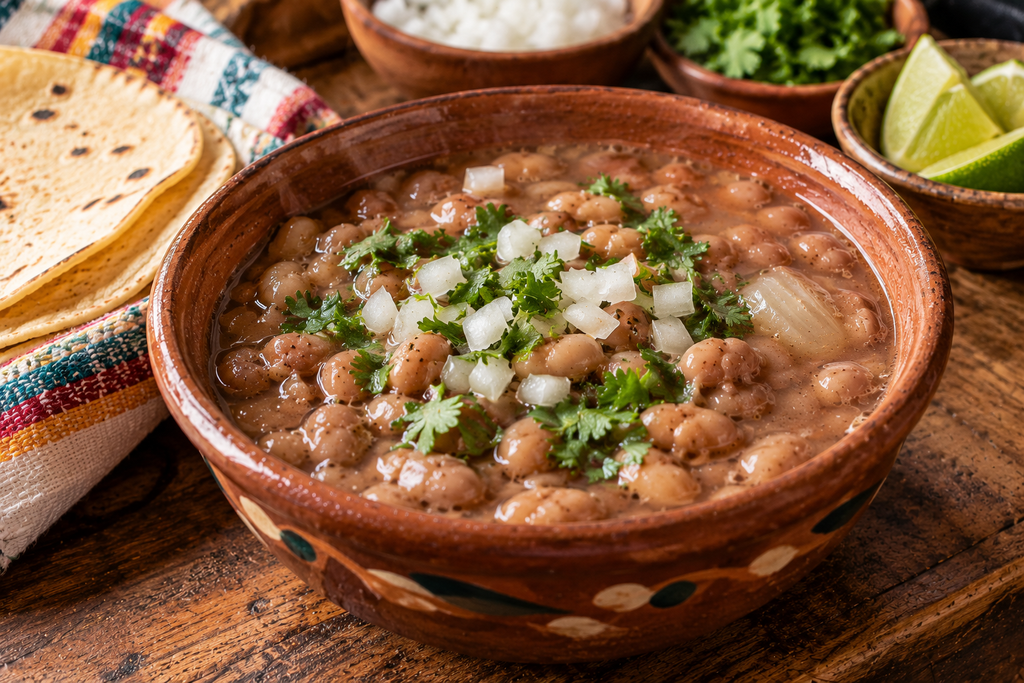
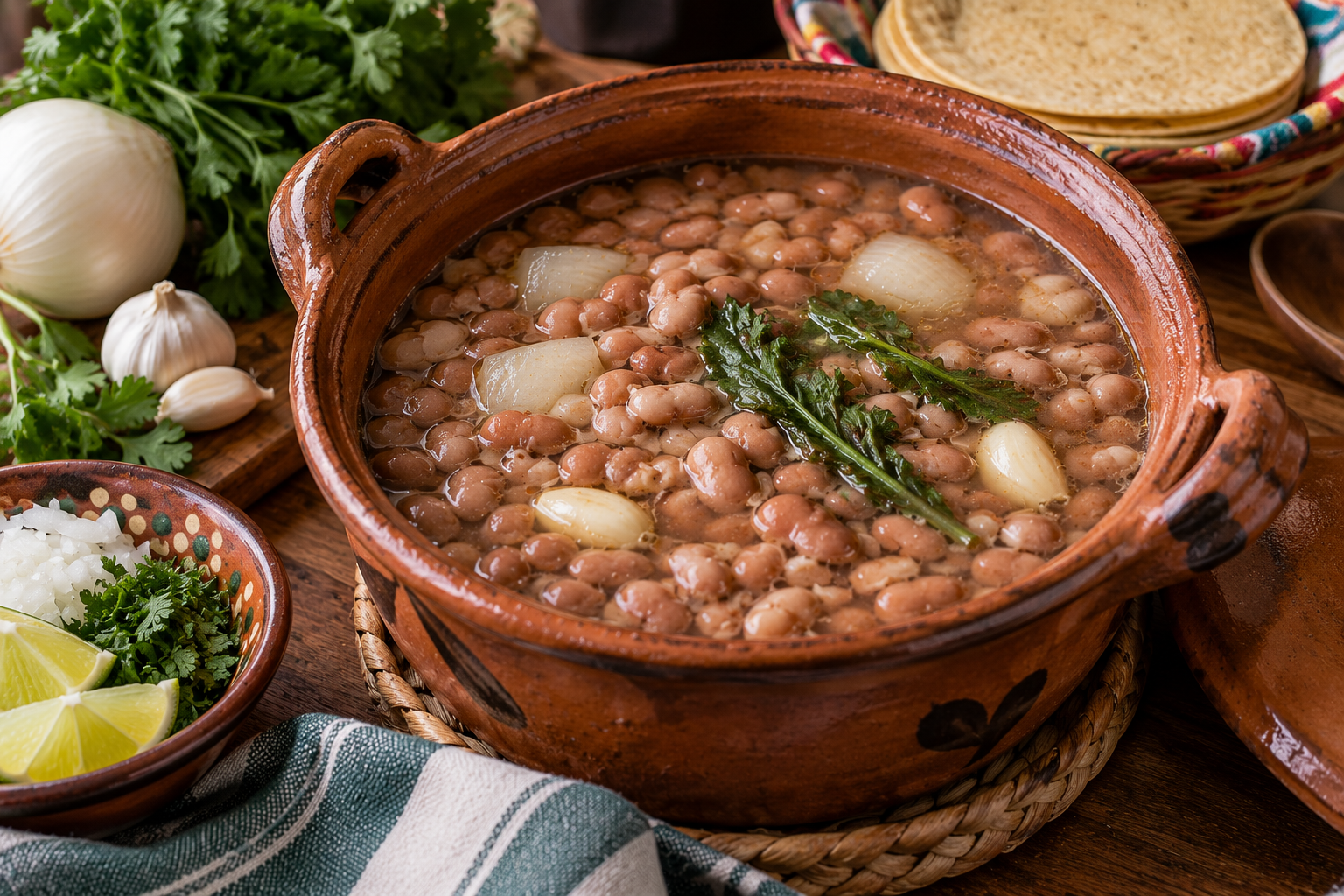
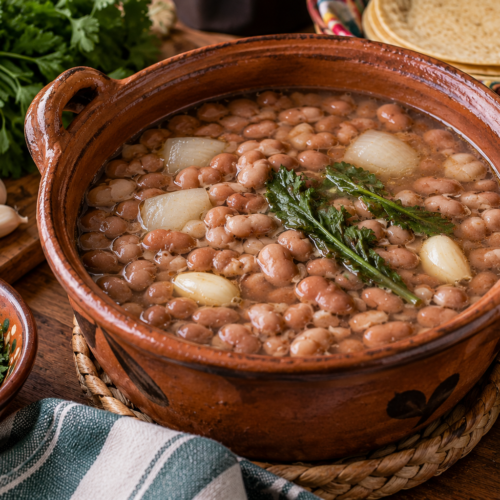
Tender, brothy frijoles de la olla finished with fresh onion and cilantro and served with warm corn tortillas for a simple Mexican comfort classic.
The Final Bite
Some dishes tell you where Mexican food is going.
A pot of beans tells you where it came from.
Not because today’s frijoles de la olla are frozen in time.
They’re not.
Different families use different beans.
Different regions use different herbs.
Some cooks soak them.
Some don’t.
Some add fat.
Some keep the pot as simple as beans, water, aromatics, and salt.
That’s exactly the point.
A dish doesn’t survive for thousands of years because everybody agrees on one recipe.
It survives because people keep cooking it.
They adapt it.
They use what’s available.
They feed their families with it.
And then somebody learns how to make the next pot.
When I look at frijoles de la olla now, I don’t see a side dish.
I see one of those quiet foods that has been doing an enormous amount of work without asking for much attention.
A pot on the stove.
Tortillas nearby.
Dinner today.
Something else tomorrow.
And generation after generation finding another reason to put beans back on the fire.
That’s frijoles de la olla.
The pot of beans that built a culture.
Buen provecho,
Join the Comal Crew
If you love Mexican food with a story behind it, Join the Comal Crew and get new recipes, regional food stories, kitchen tips, and everything we’re building at The Half Jalapeño delivered straight to your inbox.
And grab your free copy of 5 Mexican Salsas That Go With Everything while you’re here.