When the Kitchen Becomes a Family Gathering
Some Mexican dishes are made in a pot.
Others are made around a table.
Tamales belong to that second group.
There’s something special about the sight of a kitchen table covered with softened corn husks, a big bowl of masa, and a pot of savory filling waiting to be spooned into place.
Someone spreads the masa.
Someone adds the filling.
Someone folds the husks.
And somewhere along the way, what started as a cooking project becomes a family gathering.
That’s the beauty of making homemade Mexican tamales.
They’re not particularly complicated once you understand the process, but they do ask for something we don’t always give ourselves enough of.
Time.
Patience.
And, if you’re lucky, a few extra hands.
In the coming weeks, I’ll be making tamales with Mom, Tía Sylvia, and Uncle Jaime. I’m guessing we’ll have pork, corn, and rajas tamales, and I’m looking forward to seeing how everything comes together.
Not just because I love Mexican food.
But because making food together is one of the ways family traditions stay alive.
There are little things that don’t always make it into a written recipe.
How someone knows when the masa feels right.
How much filling belongs inside a husk.
The way one person folds a tamal differently from everyone else.
Those details are learned by doing.
And when several people gather to make tamales, the cooking becomes part of the story.
At The Half Jalapeño, our Comfort Classics series has been a celebration of the dishes that make Mexican home cooking feel like home.
We’ve explored everything from Mexican picadillo and arroz rojo to carne con papas, frijoles de la olla, and sopa de fideo.
But tamales deserve a special place in that collection.
Because they’re more than a comforting meal.
They’re a tradition built around corn, patience, and people.
And whether you’re preparing your first batch or continuing a family custom, there’s something deeply satisfying about lifting the lid of the steamer and knowing you made those tamales yourself.
At a Glance
What It Is
Homemade Mexican tamales are made with seasoned corn masa wrapped around a savory or sweet filling, enclosed in corn husks or other leaves, and steamed until tender and cooked through.
Where It’s From
Tamales have roots in Indigenous Mesoamerican food traditions that long predate Spanish colonization. Today, they’re prepared throughout Mexico, with regional differences in fillings, masa, wrappers, and cooking methods.
What Makes It Special
Tamales combine the culinary history of corn with the tradition of preparing food together. A family tamalada transforms a time-consuming recipe into a shared experience of cooking, conversation, and passing knowledge between generations.
History & Cultural Context: A Tradition Wrapped in Corn
Long before modern kitchens, electric mixers, and stainless-steel steamers, Indigenous communities throughout Mesoamerica were preparing foods made from corn.
Corn wasn’t simply another ingredient.
It was central to agriculture, daily life, community, and cultural identity.
And tamales are among the enduring expressions of that relationship.
The word tamal comes from the Nahuatl word tamalli, associated with wrapped preparations of corn dough.
The tradition reaches back to pre-Hispanic Mesoamerica, where Indigenous peoples developed ways to prepare, wrap, and cook masa-based foods.
Over the centuries, tamales evolved as ingredients, cooking techniques, and regional preferences changed.
And that evolution is important.
Because there’s no single version of a tamal that represents every part of Mexico.
A Different Tamal in Every Region
Travel through Mexico, and you’ll discover just how diverse tamales can be.
In many parts of central and northern Mexico, corn-husk tamales filled with pork, chicken, chiles, or cheese are familiar favorites.
In Oaxaca, banana-leaf-wrapped tamales are especially well known, including versions prepared with mole.
In the Yucatán Peninsula, regional tamale traditions reflect the area’s Maya culinary heritage, with preparations that may include achiote-seasoned meats and banana leaves.
Across Veracruz and other Gulf Coast regions, you’ll encounter additional variations shaped by local ingredients and traditions.
And throughout Mexico, there are sweet tamales, bean-filled tamales, vegetable tamales, and countless family versions.
Some are small.
Others are enormous.
Some have fluffy, tender masa.
Others are softer or denser, depending on the preparation.
That’s what makes Mexican cuisine so fascinating.
The basic idea of wrapping and cooking corn dough has remained recognizable for generations, but the possibilities are nearly endless.
Masa and the Genius of Nixtamalization
To understand tamales, you have to understand masa.
And to understand masa, you have to appreciate one of the most important food technologies developed in Indigenous Mesoamerica.
Nixtamalization.
Traditional nixtamalization involves cooking and steeping dried corn in an alkaline solution, often made with food-grade calcium hydroxide, before rinsing and grinding it.
This process changes the corn’s texture and flavor, helps it become workable dough, and improves the availability of certain nutrients.
It’s one of the reasons masa can become tortillas, tamales, and so many other foods central to Mexican cooking.
For generations, preparing corn and grinding it into masa was part of everyday food production.
Today, many home cooks use masa harina, a convenient flour made from nixtamalized corn.
It saves time while preserving the essential ingredient at the heart of the dish.
And when that masa is mixed with fat, broth, and seasonings, it becomes the tender foundation of a homemade tamal.
The Tamalada: When Cooking Becomes a Gathering
There’s a reason making tamales is often a group activity.
Preparing several dozen takes work.
The meat needs cooking.
The sauce needs blending.
The masa needs mixing.
The corn husks need soaking.
And then comes the assembly.
Spread the masa.
Add the filling.
Fold the husk.
Set the tamal aside.
Do it again.
And again.
And again.
That’s where the tamalada comes in.
A tamalada is a gathering where family members or friends make tamales together, often dividing the work among several people.
The exact traditions vary from household to household, but the spirit is familiar.
Everyone contributes.
Someone knows how the masa should feel.
Someone is especially good at spreading it evenly.
Someone has a folding technique that makes the tamales look almost identical.
And someone inevitably makes a tamal that’s twice the size of everybody else’s.
That’s part of the experience.
Tamales are especially associated with Christmas and other family celebrations in many Mexican and Mexican American households.
In Mexico, they also have an important connection to Día de la Candelaria on February 2.
But tamales aren’t reserved exclusively for holidays.
They’re enjoyed throughout the year, from street-food breakfasts to family dinners and special gatherings.
Three Tamale Traditions, One Family Table
One of the things I love about tamales is how different they can be while sharing the same basic idea.
For our upcoming family gathering, I’m expecting three varieties.
Pork Tamales: Savory, tender masa filled with seasoned pork, often prepared with a rich red chile sauce.
Tamales de Elote: Sweet corn tamales that highlight the natural flavor of corn and offer a softer, sweeter contrast to savory varieties.
Tamales de Rajas: Tamales featuring roasted chile strips, often poblano peppers, sometimes paired with cheese or a flavorful sauce.
Each brings something different to the table.
And together, they show how one traditional cooking method can produce completely different flavors.
For today’s recipe, we’re focusing on red chile pork tamales.
But if you love the idea of a variety-filled tamalada, you’ll also find our Tamales de Elote and Tamales de Rajas recipes in the related recipes section below.
Why This Tradition Matters
It’s easy to think of tamales as a recipe that takes a long time.
And yes, making them from scratch requires patience.
But that description misses something important.
The process creates an opportunity for people to spend time together.
It gives experienced cooks a chance to share what they know.
It gives younger family members a chance to learn.
And it creates memories around the preparation of food, not just the eating of it.
That’s why homemade tamales belong in our Comfort Classics collection.
They’re part of Mexico’s culinary history.
They’re deeply connected to the traditions surrounding corn and masa.
And they’re a reminder that sometimes the most meaningful ingredient in a family recipe isn’t something you measure.
It’s the time you spend making it together.
Ingredients Overview: Building Great Tamales From the Inside Out
Making tamales from scratch becomes much easier when you understand what each ingredient contributes.
The corn husks hold everything together.
The masa provides the structure.
The pork filling delivers savory flavor.
And the red chile sauce ties it all together.
Dried Corn Husks
Dried corn husks are used to wrap many traditional Mexican tamales.
They protect the masa during steaming and help the tamales hold their shape.
Before using them, soak the husks in hot water for 30 to 60 minutes until soft and flexible.
Choose the larger husks for assembly and save smaller or torn pieces for lining the steamer.
Substitution: Banana leaves are used in other regional tamale traditions, but they require different handling and produce a different style of tamal.
Pork Shoulder
Pork shoulder is ideal for red chile pork tamales because it becomes tender and easy to shred after slow cooking.
It also has enough natural fat to help keep the filling moist.
We’ll simmer the pork with onion, garlic, bay leaves, and salt until it’s fork-tender.
Then we’ll shred it and coat it in homemade red chile sauce.
Substitution: Boneless pork butt works equally well. Cooked shredded chicken can be used for a different variation.
Dried Guajillo Chiles
Guajillo chiles bring a beautiful red color, mild heat, and fruity, earthy flavor to the sauce.
They’re one of the foundations of many Mexican red chile preparations.
Remove the stems and seeds before softening them.
And be careful when toasting.
You want the chiles fragrant, not burned.
Dried Ancho Chiles
Ancho chiles are dried poblano peppers.
They contribute a deeper, slightly sweet flavor that balances the guajillos.
Using both chiles gives our pork filling a more rounded flavor than relying on a single variety.
White Onion and Garlic
Onion and garlic appear in both the pork cooking liquid and the red chile sauce.
They build savory depth without overwhelming the flavor of the dried chiles.
White onion is a familiar choice in Mexican cooking, but yellow onion works as a substitute.
Mexican Oregano and Cumin
Mexican oregano adds a distinctive herbal note to the chile sauce.
A small amount of cumin is optional.
We want the flavor of the chiles and pork to remain the focus.
Masa Harina for Tamales
Masa harina is made from nixtamalized corn that has been dried and ground into flour.
For this recipe, choose masa harina intended for tamales when available.
It often has a slightly coarser texture than flour used for tortillas.
Fresh masa from a Mexican market is another option, but it may already contain liquid or fat, so the recipe quantities would need adjustment.
Important: Ordinary cornmeal and cornstarch are not substitutes for masa harina.
Lard or Vegetable Shortening
Fat helps make tamale masa tender rather than heavy and dry.
Lard is traditional in many pork tamale preparations and adds richness.
Vegetable shortening is a workable alternative.
The key is beating the fat until creamy before gradually incorporating the masa harina and broth.
Baking Powder
Baking powder helps lighten the masa.
It isn’t used in every traditional tamale recipe, but it’s a common ingredient in many modern home preparations.
A small amount helps create a softer finished texture.
Pork Broth
Don’t throw away the liquid from cooking the pork.
That broth contains flavor from the meat, onion, garlic, and bay leaves.
We’ll use it in the chile sauce and the masa.
It’s one of the easiest ways to make sure every part of the tamal tastes seasoned.
Salt
Salt matters more than you might expect.
Even beautifully prepared masa can taste bland when it isn’t properly seasoned.
Taste the pork filling and adjust the seasoning before assembling.
For the masa, cook a small sample if you’d like to check the seasoning before steaming the entire batch.
As an Amazon Associate, I earn from qualifying purchases. If you buy through the links below, it helps support The Half Jalapeño at no extra cost to you. ¡Gracias!
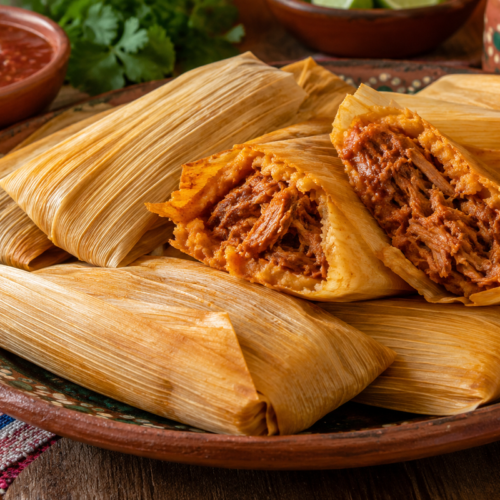
Homemade Mexican Tamales (Red Chile Pork Tamales)
Ingredients
- For the Pork
- – 3 pounds boneless pork shoulder cut into large pieces
- – 1/2 medium white onion
- – 4 garlic cloves
- – 2 bay leaves
- – 1 teaspoon kosher salt plus more to taste
- – Water to cover
- For the Red Chile Sauce
- – 6 dried guajillo chiles stemmed and seeded
- – 3 dried ancho chiles stemmed and seeded
- – 2 garlic cloves
- – 1/4 medium white onion
- – 1/2 teaspoon Mexican oregano
- – 1/4 teaspoon ground cumin optional
- – 1 1/2 cups reserved pork cooking broth plus more as needed
- – 1 tablespoon neutral cooking oil
- – Salt to taste
- For the Masa
- – 4 cups masa harina for tamales approximately 450 to 500 grams depending on brand
- – 1 cup softened lard or vegetable shortening
- – 1 1/2 teaspoons baking powder
- – 2 teaspoons kosher salt adjusted to taste
- – 3 to 3 1/2 cups warm pork cooking broth added gradually
- For Assembly
- – 30 to 36 dried corn husks
- – Additional water for soaking and steaming
Instructions
- Cook the pork.
- Place the pork shoulder in a large pot with the onion, garlic, bay leaves, and salt. Add enough water to cover.
- Bring to a boil, skim any foam from the surface, then reduce to a gentle simmer.
- Cover partially and cook for approximately 2 to 2 1/2 hours, or until the pork is fork-tender.
- Remove the pork, let it cool enough to handle, and shred it into bite-size pieces.
- Strain and reserve the cooking broth.
- Soak the corn husks.
- Place the dried corn husks in a large bowl or clean sink filled with hot water.
- Use a plate to keep them submerged.
- Soak for 30 to 60 minutes until flexible, then drain and pat dry.
- Prepare the dried chiles.
- Remove the stems and seeds from the guajillo and ancho chiles.
- Briefly toast them in a dry skillet over medium-low heat for approximately 10 to 15 seconds per side, just until fragrant.
- Transfer to a bowl, cover with hot water, and soak for 15 to 20 minutes until softened.
- Blend the chile sauce.
- Drain the softened chiles and transfer them to a blender.
- Add the garlic, onion, Mexican oregano, optional cumin, and 1 1/2 cups of reserved pork broth.
- Blend until smooth.
- For a silkier sauce, strain through a fine-mesh sieve.
- Season the pork filling.
- Heat one tablespoon of oil in a saucepan over medium heat.
- Carefully add the blended chile sauce and simmer for 8 to 10 minutes, stirring occasionally.
- Season to taste.
- Add the shredded pork and stir until evenly coated.
- The filling should be moist but not watery.
- Remove from the heat and set aside.
- Beat the fat.
- In a large mixing bowl, beat the softened lard or vegetable shortening for 3 to 5 minutes until creamy and lighter in texture.
- Prepare the masa.
- In a separate bowl, combine the masa harina, baking powder, and salt.
- Gradually add the dry ingredients to the beaten fat, alternating with warm pork broth.
- Mix until smooth and soft.
- Start with 3 cups of broth, then add more gradually if necessary.
- The masa should be easy to spread, similar to thick hummus.
- Spread the masa.
- Place one softened corn husk on your work surface with the wide end facing you.
- Spread approximately 3 tablespoons of masa over the upper, wider portion, leaving room along the sides and at the narrow end for folding.
- Add the filling.
- Place approximately 2 tablespoons of red chile pork filling down the center of the masa.
- Avoid overfilling.
- Fold the tamales.
- Bring one side of the husk toward the center, allowing the masa to fold over the filling.
- Fold the opposite side over it, then fold the narrow bottom end upward.
- Leave the upper end open or secure with a strip of soaked husk if preferred.
- Repeat with the remaining ingredients.
- Prepare the steamer.
- Add water to a large steamer pot fitted with a rack, keeping the water below the rack.
- Line the rack with spare corn husks.
- Arrange the tamales upright with the open ends facing up.
- Cover with additional husks and place the lid on the pot.
- Steam the tamales.
- Bring the water to a steady simmer.
- Steam for approximately 60 to 90 minutes, checking the water level periodically and carefully adding hot water as needed.
- Begin testing around the 60-minute mark.
- Remove one tamal and let it rest for several minutes before opening.
- The masa should be cooked through, cohesive, and release reasonably cleanly from the husk.
- If it’s still wet and pasty, continue steaming.
- Rest and serve.
- Turn off the heat and allow the tamales to rest for 10 to 15 minutes.
- Serve warm with salsa, beans, or your favorite Mexican sides.
Notes
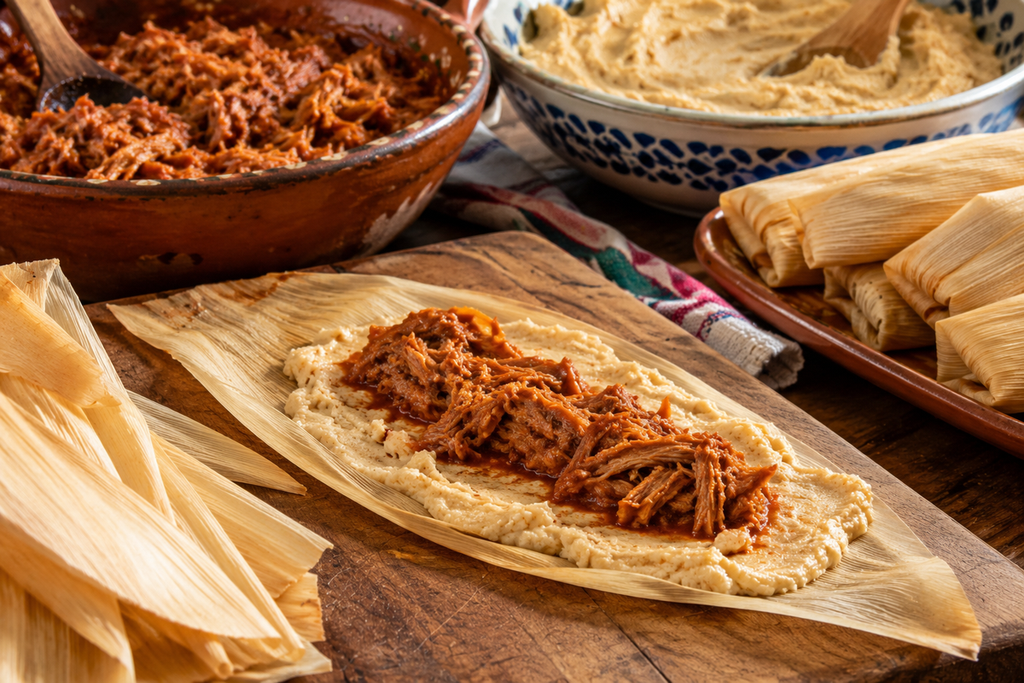
Spread the masa, add the savory red chile pork, and fold the husks. Every homemade tamal starts with a little patience and a whole lot of flavor
Kitchen Wisdom: The Little Details That Make Great Tamales
Here’s something worth knowing before you make your first batch.
The difference between a good tamal and a disappointing one often comes down to details that seem small.
The consistency of the masa.
The moisture in the filling.
The amount of dough spread on each husk.
And the patience to let everything steam properly.
Once you understand those details, tamale-making becomes much less intimidating.
The Masa Should Be Soft, Not Stiff
One of the most common problems with homemade tamales is heavy, dry masa.
It can happen when there’s too little fat, too little liquid, or too much masa harina.
When you spread the dough across a corn husk, it should move easily under the back of a spoon.
If you’re fighting to spread it, the dough may be too stiff.
Add a little warm broth, mix thoroughly, and check again.
You want masa that holds its shape without feeling dense.
Don’t Rely Entirely on the Float Test
Some cooks use the float test to check tamale masa.
They drop a small piece of dough into water and see whether it floats.
The idea is that well-beaten dough contains enough air to rise.
It’s a familiar kitchen technique, but it isn’t a foolproof measure of proper hydration or how the masa will cook.
Pay attention to the dough’s texture, seasoning, and consistency.
If you’re uncertain, make a small test tamal and steam it before assembling the entire batch.
That tells you more about how your particular dough will behave.
The Filling Should Be Flavorful, Not Watery
Red chile pork filling needs enough sauce to stay moist.
But too much liquid can create problems.
A watery filling makes the tamales harder to assemble and can leave the surrounding masa soggy.
Let the sauce reduce until it coats the shredded pork.
You should be able to spoon the filling onto the masa without liquid running everywhere.
Corn Husk Size Matters
Not every dried corn husk is the same size.
Some are wide and easy to work with.
Others are narrow, short, or torn.
Use the larger husks for your first few tamales while you’re learning the folding technique.
If a husk is too small, overlap two softened husks to create a wider surface.
Save the smaller pieces for lining the steamer.
There’s no need to waste them.
Don’t Pack the Steamer Too Tightly
Tamales need steam circulating around them to cook evenly.
Arrange them upright with the open ends facing up.
They should support one another without being crammed so tightly that steam has trouble moving through the pot.
If you’re preparing a very large batch, use multiple steamers or cook in batches.
And always keep an eye on the water level.
A steamer that boils dry can ruin hours of work.
Give the Tamales Time to Rest
Freshly steamed tamales can feel softer than expected.
That doesn’t automatically mean they’re undercooked.
The masa continues firming as it rests.
Let a test tamal sit for several minutes before peeling back the husk.
If the dough is cohesive and releases reasonably cleanly, you’re in good shape.
If it’s still wet and pasty, return the tamales to the steamer.
Turn the Work Into an Assembly Line
If you’re making several dozen tamales, organization makes a huge difference.
Set up your ingredients before you begin.
Keep the softened husks in one area.
Place the masa in a large bowl.
Keep the filling close by.
And have a tray ready for completed tamales.
Then find a rhythm.
Spread.
Fill.
Fold.
Repeat.
That’s one of the reasons tamaladas work so well.
The work becomes easier when everyone has a role.
And the kitchen becomes a place for conversation instead of just another chore.
What to Serve With Homemade Mexican Tamales
A freshly steamed tamal doesn’t need much.
Peel back the corn husk, let the steam escape, and enjoy the tender masa and savory filling.
But tamales also fit beautifully into a larger Mexican meal.
Frijoles de la Olla
A pot of slow-simmered beans is one of the simplest and most satisfying companions for homemade tamales.
The beans bring a comforting, savory flavor that balances the richness of the pork and masa.
Arroz Rojo
Mexican red rice is another classic side.
Its tomato-rich flavor pairs naturally with red chile pork tamales and helps turn a few tamales into a complete family dinner.
Salsa Verde or Salsa Roja
A spoonful of salsa adds brightness and extra flavor.
Choose a tangy salsa verde for contrast or a smoky salsa roja if you want to build on the chile flavors already in the filling.
Pickled Jalapeños and Fresh Vegetables
Something acidic or crisp can help balance the richness of tamales.
Pickled jalapeños, sliced radishes, or a simple fresh salad are all good options.
Atole or Café de Olla
For breakfast or a holiday gathering, tamales are often enjoyed with a warm drink.
Atole, a traditional masa-based beverage, is a particularly fitting companion.
Café de olla is another comforting choice.
And sometimes?
The best thing to serve with a tamal is another tamal.
Storage & Reheating
One of the best things about making a large batch of tamales is knowing you’ll have more waiting for another day.
Tamales refrigerate well, freeze beautifully, and can be reheated without sacrificing too much of their original texture.
Refrigerating
Allow cooked tamales to cool briefly, then transfer them to shallow airtight containers and refrigerate within two hours.
Leave the corn husks on to help protect the masa from drying out.
Store refrigerated tamales for up to 3 to 4 days.
Freezing
Tamales are excellent for freezing.
Once fully cooked and cooled, arrange them in freezer-safe bags or airtight containers with the husks still attached.
Remove excess air and label the containers with the date.
For best quality, enjoy them within approximately 2 to 3 months.
Reheating by Steaming
Steaming is my preferred method because it helps restore moisture without making the masa greasy.
Place refrigerated tamales in a steamer over simmering water and heat for approximately 15 to 20 minutes, or until thoroughly heated.
Frozen tamales can be steamed directly from the freezer but will take longer, often 25 to 40 minutes depending on their size.
For food safety, reheat leftovers to an internal temperature of 165°F.
Reheating in the Microwave
For a quick option, wrap a tamal in a damp paper towel and place it on a microwave-safe plate.
Heat in short intervals until hot throughout.
The exact time depends on the size of the tamal and your microwave’s power.
Let it rest briefly before unwrapping.
Making Tamales Ahead
You don’t have to complete every step in one day.
Cook the pork and prepare the red chile sauce in advance.
Refrigerate them in airtight containers, then prepare the masa and assemble the tamales the following day.
Breaking the process into stages can make a large family batch much easier to manage.
My Go-To Tools for Mexican Cooking
These are the tools I personally recommend for building real Mexican flavor at home, the kind that gets stained with salsa, smells like toasted chiles, and earns a permanent spot in your kitchen.
Cast Iron Tortilla Press – Fresh tortillas make every taco better.
Cast Iron Skillet (Comal Alternative) – Perfect for searing meats, warming tortillas, and building incredible flavor.
Tortilla Warmer – Keeps tortillas soft, warm, and ready for taco night.
Non-Stick Comal – One of the best tools for roasting tomatoes, tomatillos, garlic, onions, and chiles.
Ninja Professional Blender (1000W) – Essential for silky salsa verde, salsa roja, marinades, and sauces.
Granite Molcajete – The traditional way to make salsa with unbeatable texture and authentic flavor.
Wooden Rolling Pin – A versatile kitchen staple that always earns its keep.
Lodge 6-Quart Enameled Dutch Oven – Perfect for birria, barbacoa, beans, soups, stews, braises, and slow-cooked Mexican favorites.
Mexican Kitchen Essentials
For the tools I use to make tacos, salsas, sides, and everyday Mexican food at home:
👉 Shop My Mexican Kitchen Essentials
Frequently Asked Questions
1. What are traditional Mexican tamales made of?
Many traditional Mexican tamales are made with seasoned corn masa, a savory or sweet filling, and a wrapper such as dried corn husks or banana leaves. They’re steamed until the masa is cooked through. Ingredients and techniques vary by region and family.
2. What is the best meat for pork tamales?
Pork shoulder is an excellent choice because it becomes tender and easy to shred after slow cooking. Its natural fat helps keep the filling moist and flavorful.
3. Why are my homemade tamales dry?
Dry tamales can result from masa that doesn’t contain enough liquid or fat, overly thick layers of dough, or excessive cooking. The masa should be soft and spreadable before assembly.
4. How do I know when tamales are done?
Remove a test tamal from the steamer and allow it to rest for several minutes. The masa should be cohesive, cooked through, and release reasonably cleanly from the husk. If it’s still wet and pasty, continue steaming.
5. How long do Mexican tamales take to steam?
Many medium-size tamales take approximately 60 to 90 minutes, although cooking time depends on their size, thickness, filling, and steamer. Larger tamales may need additional time.
6. Can I make tamales without lard?
Yes. Vegetable shortening is a common alternative. The flavor may differ, but properly mixed and hydrated masa can still produce tender tamales.
7. Can I use fresh masa instead of masa harina?
Absolutely. Fresh masa can be an excellent choice, but it may already contain moisture, fat, or seasoning. Adjust the recipe accordingly rather than substituting it cup for cup without checking its consistency.
8. Why is my masa sticking to the corn husks?
The tamales may need additional steaming time or a longer rest after cooking. Excessively wet masa can also contribute to sticking. Test a rested tamal before deciding the entire batch needs more cooking.
9. Can I freeze homemade Mexican tamales?
Yes. Cooked tamales freeze very well. Leave the husks on, cool them promptly, and store them in airtight freezer-safe containers. Steam them directly from frozen when you’re ready to enjoy them.
10. What is a tamalada?
A tamalada is a gathering where family members or friends prepare tamales together. People often divide the work of mixing masa, preparing fillings, spreading dough, folding husks, and steaming the finished tamales.
More From The Half Jalapeño
From slow-simmered family favorites to the everyday dishes that bring everyone to the table, these Mexican comfort classics celebrate the same traditions, flavors, and home-cooked goodness that make tamales so special.
Tamales de Elote: Sweet Corn Tamales That Steal the Morning
Soft, sweet, and bursting with fresh corn flavor, these traditional-style tamales show just how deliciously different Mexico’s tamale traditions can be.
Tamales de Rajas: The Steamy, Spicy Breakfast from the Capital
Tender corn masa wrapped around roasted poblano strips and savory filling makes these tamales a flavorful alternative to the classic pork version.
Rajas con Crema: Smoky, Creamy Comfort in a Pan
Roasted poblano peppers, sweet onions, and rich Mexican crema come together in a comforting dish that’s perfect for anyone who loves the flavors of rajas tamales.
Frijoles de la Olla: The Pot of Beans That Built a Culture
Slow-simmered beans with a rich, savory broth bring one of Mexico’s most essential cooking traditions to the table and make a wonderful companion to homemade tamales.
Arroz Rojo: The Rice That Belongs on Every Mexican Table
Fluffy, tomato-infused Mexican rice adds familiar flavor and color to a plate of freshly steamed tamales, making any family meal feel complete.
Explore Our Comfort Classics Collection
From Mexican picadillo and carne con papas to sopa de fideo and homemade tamales, discover the dishes that celebrate the heart, history, and everyday traditions of Mexican home cooking.
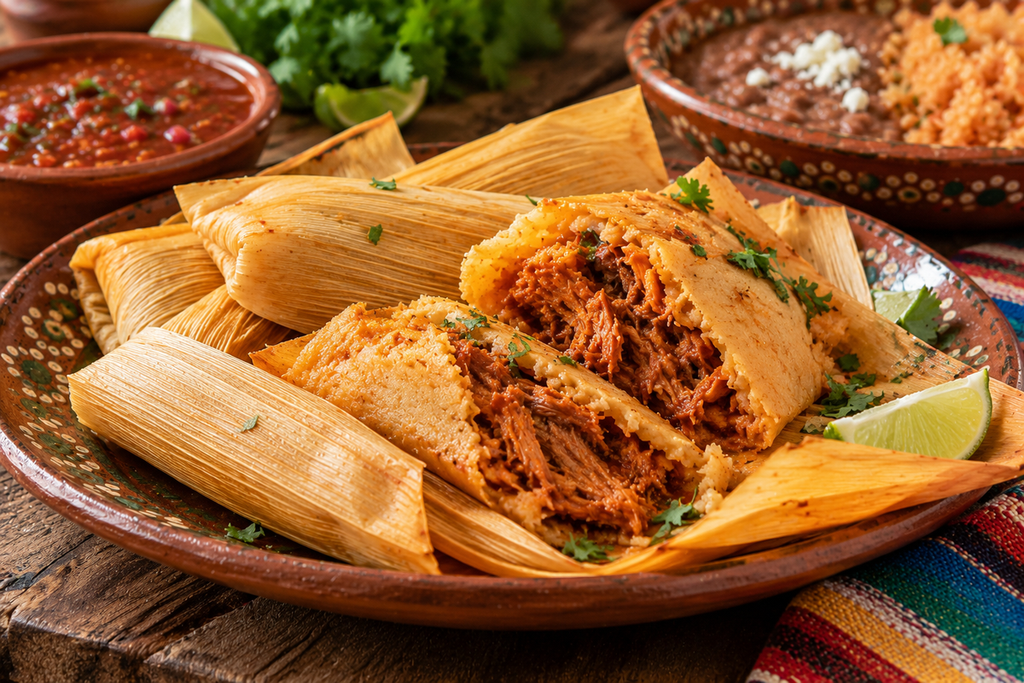
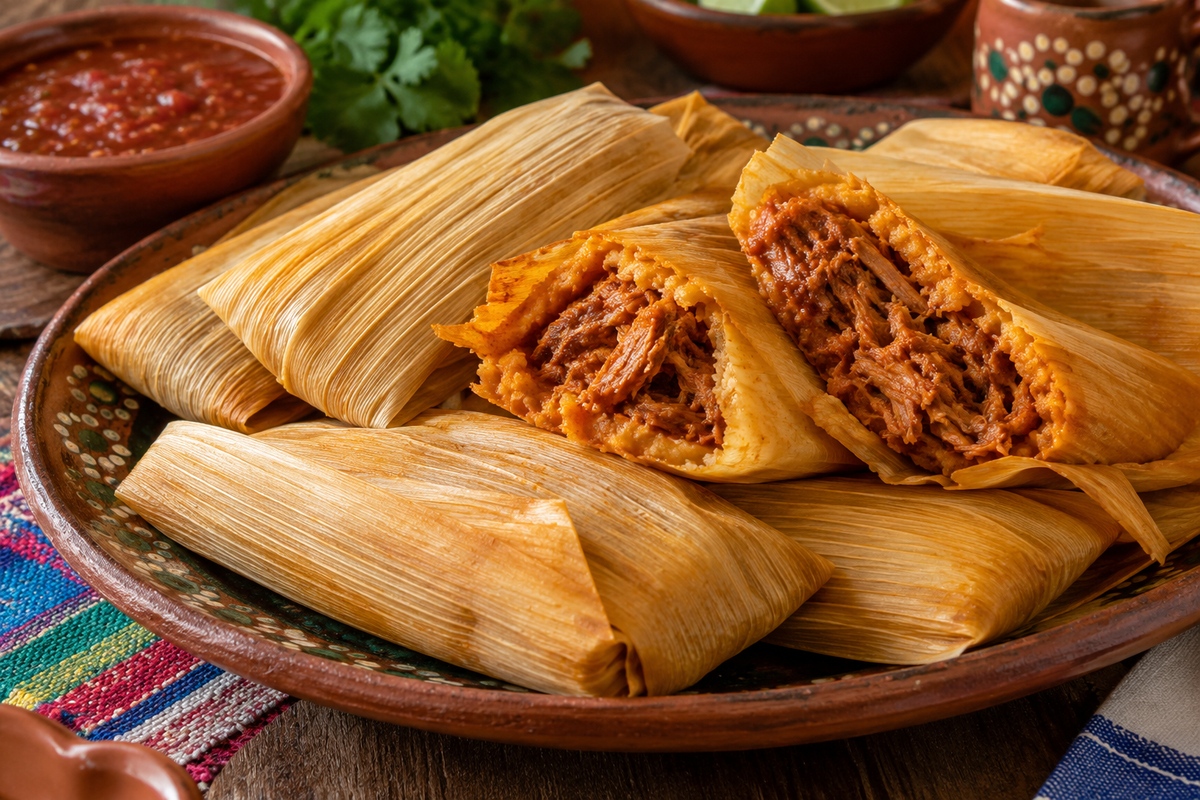
Freshly steamed, filled with savory red chile pork, and wrapped in tradition. These homemade Mexican tamales bring generations of flavor and family together at the table
The Final Bite
There’s a moment in making tamales when the kitchen finally grows quiet.
The husks have been soaked.
The masa has been mixed.
The filling has been prepared.
And the last tamal has found its place in the steamer.
Now all that’s left is waiting.
But if you’ve spent the afternoon making tamales with people you love, you’ve already gotten something valuable out of the day.
The conversations.
The shared work.
The little lessons passed from one person to another.
And maybe a few imperfectly folded tamales that everyone will enjoy anyway.
That’s what makes this dish special.
Not because every tamal has to look perfect.
Not because there’s only one correct family recipe.
But because the tradition gives people a reason to gather, work together, and create something worth sharing.
In the coming weeks, I’ll be making tamales with Mom, Tía Sylvia, and Uncle Jaime.
And I’m looking forward to everything that comes with it.
The work.
The conversations.
The food.
And the opportunity to spend time together preparing something that connects us to generations of Mexican cooking.
That’s the kind of story I want The Half Jalapeño to keep telling.
Because some recipes feed you for an afternoon.
Others stay with you for generations.
Buen provecho,
Join the Comal Crew
Love Mexican food with a story?
Join the Comal Crew for a new Mexican recipe, regional food story, and kitchen tip delivered to your inbox every Tuesday.